
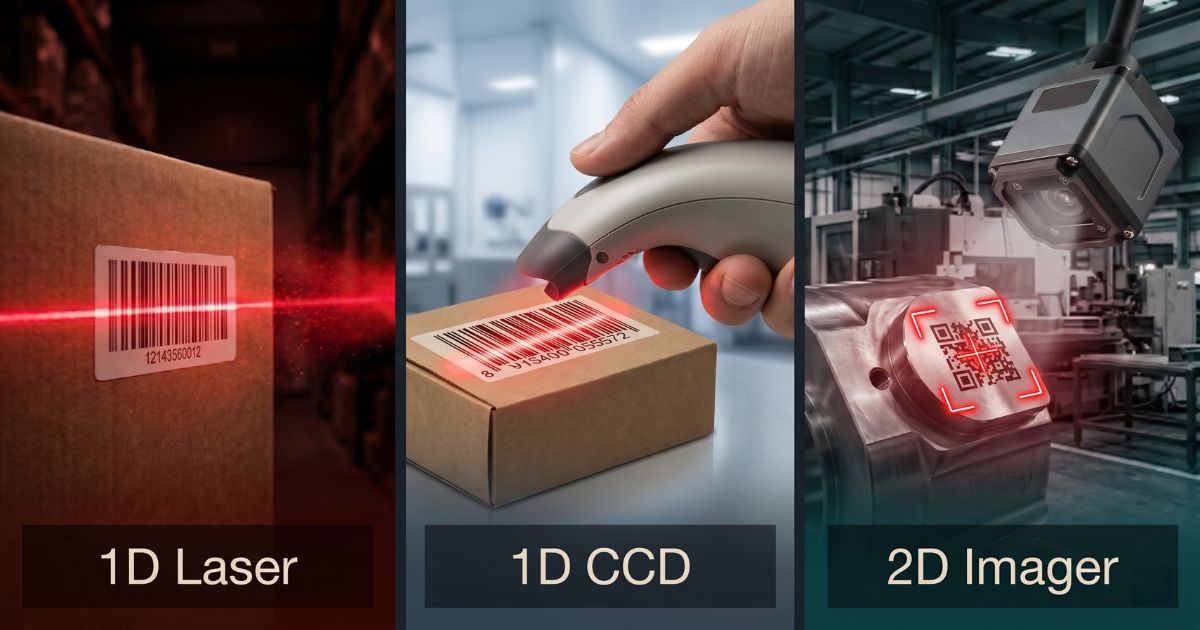
Understanding Barcode Scanner Light Sources: Laser vs LED vs Imager
Why Light Source Is More Than a Spec Sheet Detail
When most people evaluate barcode scanners, they focus on connectivity, ruggedness rating, and price. The light source technology — laser, LED, or imager — often appears as a secondary specification, treated as interchangeable. It is not.
The light source is the fundamental determinant of what a scanner can read, how it reads it, and in which environments it performs reliably. A laser scanner and an area imager can look nearly identical in a product photo; their real-world capabilities are categorically different. Understanding this distinction is a prerequisite for any informed scanner selection decision.
This article explains how each light source technology works, where each genuinely excels, and where each has hard limits — giving you the framework to match the right technology to your environment before you commit to a purchase.
Laser Scanners: Speed, Range, and 1D Precision
Laser barcode scanners generate a coherent, single-wavelength beam — typically red, at 650nm — and direct it across the barcode using an oscillating mirror. The reflected light pattern is captured by a photodiode, which converts the varying intensity into an electrical signal that the decoder processes.
The defining characteristic of laser scanning is depth of field: the range of distances over which the scanner can successfully read a barcode. Standard laser scanners read reliably at 5–60cm. Long-range laser modules — used in high-bay warehouse applications — can achieve reads at 3–9 meters or beyond, making laser the only practical choice for pallet scanning from a forklift or reading barcodes on elevated shelving without a lift.
Where laser scanners excel:
- High-speed conveyor scanning where the beam sweep speed matches line velocity
- Long-range reading in warehouse and distribution center environments
- Environments requiring consistent performance on standard 1D barcodes (UPC, Code 128, ITF-14)
- Operations where the narrower beam width improves precision in reading adjacent barcodes in close proximity
The hard limit: laser scanners read in a single line. They cannot natively decode 2D symbologies (QR, Data Matrix, PDF417) without an additional 2D-capable module. As 2D barcodes become more prevalent — driven by GS1 2D adoption mandates in retail and pharmaceutical traceability requirements — laser-only operations face increasing incompatibility with incoming label formats.
LED and Linear Imagers: The Versatile Middle Ground
LED and linear imager scanners replace the laser beam and oscillating mirror with a broad LED illumination source and a linear CCD or CMOS sensor array. Instead of sweeping a beam across the barcode, the scanner floods the barcode area with light and captures the full image in a single exposure.
The absence of moving parts is the most operationally significant difference from laser: no mirror means no mechanical wear, lower maintenance over device lifetime, and greater tolerance of drops and vibration. Linear imagers are categorically more durable than laser scanners under field conditions.
Reading capability: Linear imagers read all 1D symbologies, and most models support common 2D codes including QR and Data Matrix — with the caveat that 2D reading on linear imagers works on small, well-printed codes but may struggle with dense, damaged, or poorly oriented 2D symbols. For operations where occasional 2D reading is required and codes are consistently printed, a linear imager covers the requirement. For operations where 2D reading is a primary workflow, an area imager is the correct choice.
Where linear imagers are the right choice:
- General-purpose warehouse scanning where 1D barcodes dominate and 2D is secondary
- Healthcare environments: no laser safety concerns, low power, easy to clean, and reliable on the variety of barcode formats found in pharmaceutical and patient ID contexts
- Retail and light industrial applications where depth of field requirements are standard
- Budget-constrained deployments where area imager capability is not required
Area Imagers: When You Need to Read Everything
Area imagers use a two-dimensional CMOS or CCD sensor array — functionally equivalent to a camera sensor — that captures the full barcode field in a single frame. The illumination pattern covers the entire sensor field of view, and the decoder processes the captured image rather than an electrical waveform from a linear sensor.
This architecture enables capabilities that are simply not achievable with laser or linear imager technology:
- Omnidirectional reading: Because the sensor captures the full 2D field, the scanner reads barcodes at any orientation — tilted, rotated, upside down — without requiring the operator to align the scanner to the barcode. In high-throughput picking environments, this meaningfully reduces the time and cognitive effort required per scan.
- Complete 2D symbology support: QR codes, Data Matrix, PDF417, Aztec, and all other 2D formats are natively supported. As GS1 continues its phased transition to 2D barcodes across retail (with a 2027 sunset date for 1D-only POS systems in some markets), area imager compatibility is an increasingly important forward-looking specification.
- Screen display reading: Area imagers can read barcodes displayed on phone or tablet screens — relevant for mobile ticketing, digital loyalty programs, and any workflow where the barcode source is a device rather than a printed label.
- Direct Part Marking (DPM): Barcodes etched or dot-peened directly onto metal or plastic surfaces — common in automotive and aerospace component tracking — require high-contrast imaging and specialized illumination. Area imagers with DPM capability handle these where laser and linear imager cannot.
- Damaged and low-contrast label recovery: Area imagers apply image processing algorithms and 2D error correction (in applicable symbologies) to recover data from partially damaged, smeared, or low-contrast labels that would produce no-reads on laser or linear systems.
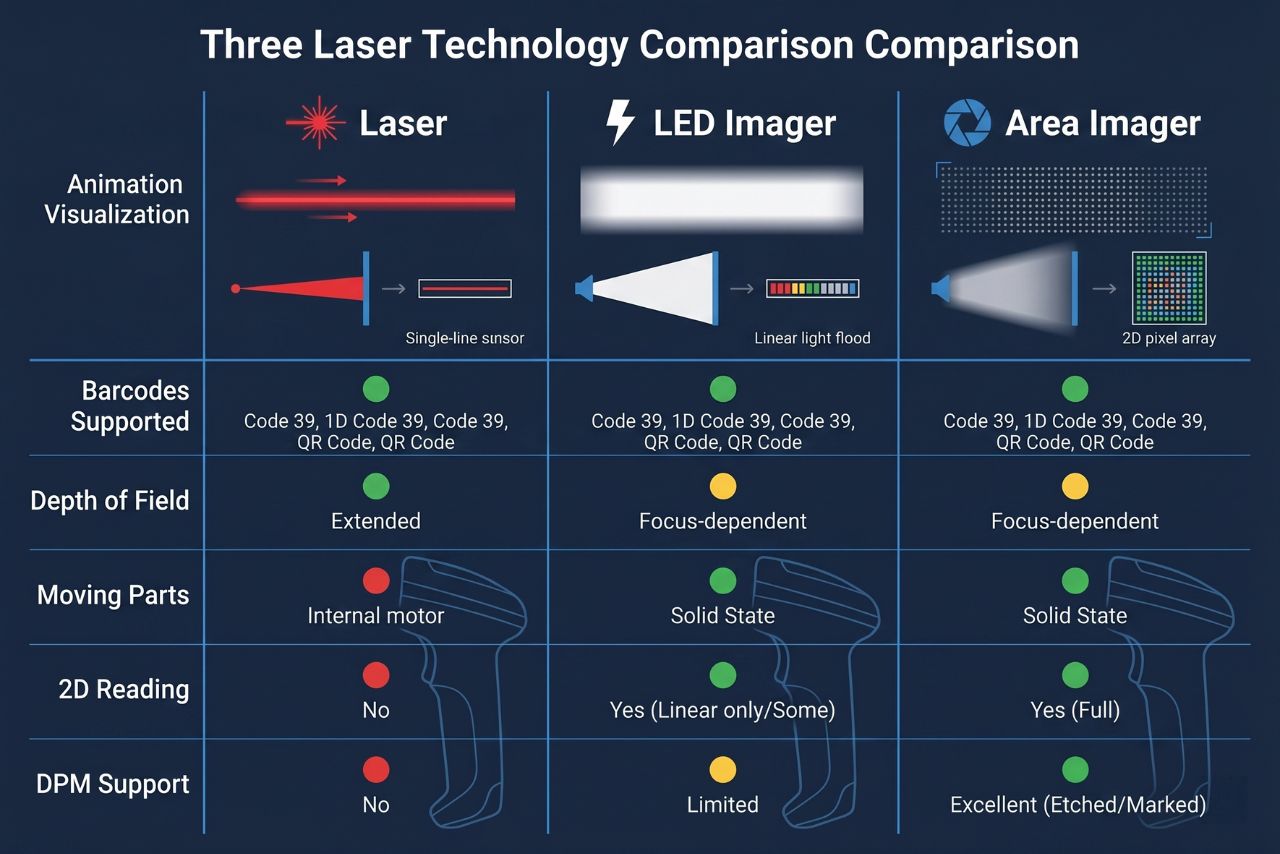
Side-by-Side: The Decision Table
The table below maps nine performance and capability dimensions across the three light source technologies. Use it as a reference framework alongside your specific environment requirements.
| Factor | Laser Scanner | LED / Linear Imager | Area Imager (2D) |
|---|---|---|---|
| Barcode Types | 1D only | 1D + most 2D | 1D + all 2D + DPM |
| Reading Motion | Sweep (moving beam) | Single-exposure flash | Single-exposure, omnidirectional |
| Moving Target | Excellent | Good | Good–Excellent |
| Depth of Field | Long (up to 5m+ with high-power) | Short–Medium | Medium (varies by model) |
| Damaged Labels | Good contrast recovery | Moderate | Best — error correction enabled |
| Screen / DPM Reading | No | Limited | Yes |
| Moving Parts | Yes (mirror) | No | No |
| Power Draw | Medium | Low | Medium |
| Typical Use | Retail POS, conveyor (1D high-speed) | General warehouse, healthcare, retail | Manufacturing, e-commerce, mixed-code |
Note on depth of field: the figures above represent general categories. Specific depth of field for any given scanner depends on the model, the barcode density being read, and the ambient lighting conditions. Always verify with the device datasheet for your specific label size and minimum bar width.
Matching Light Source to Your Environment
- Laser scanner: if your operation reads exclusively 1D barcodes, requires extended read range (>60cm), and runs high-speed conveyors where beam-sweep speed is an advantage. Typical environments: high-bay warehouses, distribution center conveyors, pallet scanning.
- LED / Linear imager: if your operation is primarily 1D with occasional 2D requirements, values device durability over extended range, and operates in environments where laser safety or power draw is a consideration. Typical environments: healthcare, retail, general warehousing.
- Area imager: if your operation reads 2D codes as a primary workflow, requires omnidirectional scanning, needs to read from screens or DPM surfaces, or is planning for GS1 2D barcode adoption. Typical environments: e-commerce fulfillment, manufacturing traceability, mobile ticketing, pharmaceutical dispensing.
Light source selection also interacts with connectivity and form factor decisions — a long-range laser module in a handheld is a different product than the same module in a fixed-mount conveyor unit.